
HeirPros - An Heir Search Firm for Probate Attorneys
★★★★★
4.8/5 based on 209 client reviewsClients rate our Genealogy Researchers
Visit TrustPilot for more reviews – [click here]
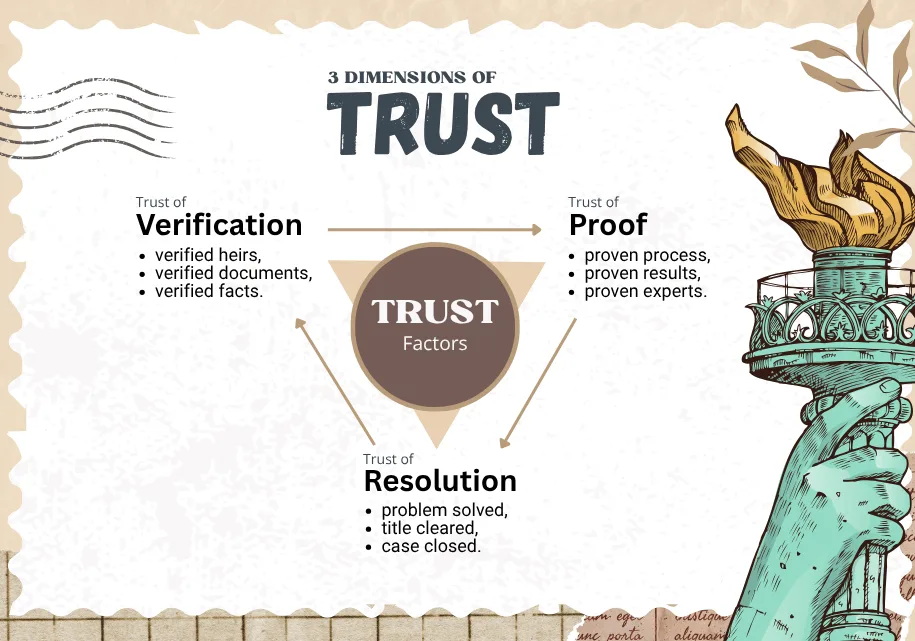
- Verification – verified heirs, verified documents, verified facts
- Proof – proven process, proven results, proven experts
- Resolution – problem solved, title cleared, case closed
What does HeirPros do?
HeirPros is a US heir search firm, founded in 2015, that identifies, locates and documents missing heirs for probate attorneys, executors and trustees. A straightforward domestic search takes 5 to 10 business days, at a flat fee from $595. Our genealogists and legal experts provide court-ready documentation for heir searches, probate searches and property beneficiary searches.
Trusted by Law Firms and Estate Professionals
HeirPros works with law firms, probate attorneys, and estate professionals across the United States who require reliable heir research and documentation.



“ We were stuck on locating 1 heir. HP found them in 1 week. Case closed. No more billable hours wasted.
“ We’re saving 30-50 billable hours per estate. At $250/hour, that’s $7,500 – $12,500 per case saved.
“ We scaled from 5 to 12 attorneys. HeirPros let us handle that growth without hiring. That’s real leverage.
Featured on JD Supra
HeirPros shares heir search insights and probate research guidance with attorneys nationwide on JD Supra.

How does an heir search work?
An HeirPros heir search takes 3 steps: tell us about your case, purchase a package, download court-ready documents.
Step 1
Tell Us About Your Case
Tell us a little about your case using our free quote calculator, or simply contacting us.
Step 2
Purchase a Package
Once we inform you of the best package for your case, you may proceed with the purchase.
Step 3
Download Court-Ready Documents
Communicate directly with your researcher and download all court-ready documents.
Who does the research?
Our team of professional investigators plays a critical role in finding unknown heirs. Their key responsibilities include:
- Research and Analysis: Using various resources such as public records, genealogy databases, and historical documents to identify potential missing heirs.
- Legal Knowledge: Understanding the legal framework surrounding estates and inheritances to navigate the search effectively.
- Interviewing and Field Work: Conduct interviews and visit locations to gather information and follow leads.
- Documentation and Verification: Gathering sufficient documentation to verify the heir’s identity and legal claim to the inheritance.
- Collaboration with Legal Entities: Working closely with lawyers, estate executors, and courts to ensure all potential heirs are accounted for.
- Probate Court Interaction: Presenting findings to probate courts and assisting probate attorneys to ensure smooth estate settlements.
Clients rate our Genealogy Researchers ★★★★★ 4.8/5 based on 209 client reviews

Quentin, skilled and experienced professional researcher, an author, a film and video producer, a businessman, and a former Central Intelligence Agency (CIA) case officer. His University of Utah degree and his work in the intelligence community gave him a deep knowledge of research and investigative techniques that he has continued to use in later years. He has been an avid private investigator and professional genealogical researcher for over 50 years and has handled cases for more than 200 clients in more than 30 countries.

Megan, a retired corporate litigation partner at a major law firm and now a professional genealogist. She has over 20 years of experience in U.S. genealogical research – including Colonial New England – and has helped many clients uncover their roots in Ireland and Italy. In several cases she has used DNA analysis in combination with documentary research to solve genealogical mysteries.

Kim, a gifted family historian and an internationally respected qualitative researcher with an interest in social history. She has conducted genealogical research for over 20 years and as professional for the past 10 years. Kim has a doctoral degree in the social sciences and a post-graduate diploma in genealogical studies. Having a Metis heritage, she has a significant interest in Metis, Native American, French-American/Canadian, Creole and early American/Canadian genealogy. Customers describe Kim as a problem solver.

Tone, is your Norway, Denmark, Sweden, & early Finnish expert. She completed all of her education in the cities of Oslo & Bergen. Speaks English, Swedish, Danish, Spanish & German. Her proximity to the Salt Lake Library enables her for quick archive retrievals & other resources.

Linda, your project manager. Linda will coordinate people and processes to ensure that your projects are delivered on time and produce the desired results. She is the go-to person for everything involving a project’s organization and timeline. She’s focused on assuring professionalism, promptness, and your satisfaction.
Joyce, 40+ year veteran professional researcher has been accredited by the Family History Library and by ICAPGEN in Isle of Man and English genealogy research since 1992. In addition, she is extremely knowledgeable in Irish, Scottish, U.S. and a few other types of genealogical searches. Well experienced in genealogy, family history research, and tracing roots. She is an extremely effective researcher and often ask for by name by new customers. Joyce credits genealogy and family history research with keeping her “sane” and staving off Alzheimers.
Nancy, specializes in heir research or probate research cases. Earning her PLCGS credential in Methodology and American Records, she needs be your next genealogy export for your estate settlement research report; if you want it done correct the first time. You’ll find her education, her skills, and her passion all match and visible in her reports. So much so that her reports are usable in court and Nancy is available for testimony, if required. Due to her expertise in American records, Nancy is aspires to solve your next American genealogy roadblock.
Ed, professional researcher with 10+ years of experience. Helped explained a mystery surrounding the names in an old bible which seemed to not match the bible’s owners names to working with DNA to not only see matches but pin down exactly how we are connected.
Blain, DNA expert and a professional genealogist with more than 10 years of experience. Blain helps our team crack some complicated DNA analysis roadblocks, along side providing his genealogy expertise.
George, working out of the New York state, George has access to an array of resources. His 20+ years in genealogy helps us uncover ship records, immigration records, and much more. George has solved so many immigration roadblocks, it’s amazing.
What heir search services does HeirPros offer?
Heir Search and Probate Research: Our expert genealogists provide comprehensive legal genealogical research to reconstruct family lineages, locate missing heirs, find beneficiaries, and prove their rights to an inheritance. We ensure that all legally entitled heirs are identified before any property sale or transfer is completed.
Kinship Research: We specialize in reconstructing family lineages where the next of kin is unknown, helping to locate heirs and find missing beneficiaries.
Estate Documentation: Having the right papers is super important in probate cases. We help get birth, marriage, and death certificates, wills, and other key records. We pay close attention to details to make sure all the needed paperwork is ready. This cuts down on delays and legal problems.
International Heir Searches: HeirPros is equipped to handle cases with international dimensions. Our worldwide team of researchers lets us do deep searches in many countries. This means we don’t miss any possible heirs, no matter where they live.
Court-Ready Documentation: Courts accept our case reports as official papers. If needed, our team is available to appear in court for testimonies.
Full Report of Findings: We provide a complete report of our findings, including all relevant sources and copies of records, with translations if applicable.
Why do probate attorneys choose HeirPros?
- 98% Success Rate: We pride ourselves on a high success rate in completing missing heir searches. Our professional genealogists are skilled in reconstructing family lineages and identifying all legally entitled heirs.
- Fast Turnaround: We can start your search today, and a straightforward domestic search takes 5 to 10 business days.
- Direct Communication: When you work with HeirPros, you can talk straight to our experts whenever you need to during the whole process.
- Flat Fees from $595: No surprise fees, and never a percentage of the estate.
- International Search Abilities: Our researchers work in the US and internationally.
What do you get with an HeirPros heir search?
- All purchased time used towards research,
- Service from a Professional Genealogist,
- Full report of findings and their sources,
- A time-log report,
- Copy of all records, with translation if applicable,
- Printed version of all found records, if needed.
Why does finding missing heirs matter for the executor?
As an executor, administrator, or attorney, you remain personally responsible if some entitled parties were left out and the estate distributed incorrectly.
Here’s how locating missing heirs helps administer the estate.
Statutory Compliance: The law dictates the exact share of the estate that goes to which degree of kinship. So, an executor conducts heir search because distributing assets wrongly is an illegality that violates probate statutes.
Fiduciary Duty: As a court-appointed executor or administrator, you act as a fiduciary. You’re therefore expected to present your local equivalent to an affidavit of diligent search proving that you explored every reasonable avenue, including professional heir search services.
Evidentiary Verification: When substantial assets are at stake, fraudulent and mistaken claims are not uncommon. Heir search helps you build a verifiable audit trail, with records like birth certificates, as a court-admissible chain of evidence that legally bars illegitimate claimants.
Clear Chain of Lineal Descendancy: A gap in the bloodline means shares may not pass to buyers. This makes it necessary to trace family tree branches to legally transfer or sever property rights, ensuring assets can be liquidated cleanly.
Indemnification: Performing a thorough heir search allows you to obtain court clearance from any future liability, even if a missing beneficiary surfaces years later.
Share Your Probate Matter with Us
HeirPros handles all heirship questions while your office handles the core probate administration.
We follow all leads to establish the chain of kinship, find the missing heirs, clear the title, and document due diligence across the United States, Canada, and Europe.
Tell us about your probate matter so we can discuss the most straightforward way forward and tailor the research to the facts of the estate.
Forensic Genealogy
Over-reliance on the traditional paper trail inevitably leads to catastrophic gaps. That is why we integrate forensic genealogy into our investigative toolkit.
The aim of forensic genealogy is to fortify the civil registry. An accredited chain-of-custody DNA match, for example, can provide definitive corroboration that insulates your practice.
How does HeirPros prove due diligence in court?
HeirPros proves due diligence with a documented audit trail of every record searched, backed by affidavits and, if needed, expert testimony in court.
The value of your petition before the court lies in proving that you exhausted every lead when painting the heirship picture.
HeirPros provides a verifiable audit trail structured to survive cross-examinations and adversarial hearings.
Our affidavits, documented heirship reports, and supporting research protect your professional liability if a disgruntled claimant challenges the distribution or an omitted heir surfaces years later.
If any questions arise on the methodology of those findings, our researchers are ready to appear in court for expert testimony.
Start your heir search with HeirPros today and ensure that you close your current file with total procedural efficiency and confidence.
Client results
“Cleared the Chain of Title”
“The court appointed guardian ad litem was very skeptical of our kinship petition but when we retained HeirPros on our intestacy file, they delivered an ironclad search backed by certified records from the three countries involved. We started with no known descendants but HeirPros conducted a cross-border field investigation that strengthened our affidavit of diligent search prompting the GAL to withdraw their objections and the court clearing the file for distribution.”
David S., Probate & Estate Litigation Attorney, Los Angeles, CA
“Saved a $3M Contract at the Eleventh Hour”
“Our residential property transaction had stalled because a dead aunt was rumored to have unrecorded kids out of state. This was a major gap in the lineal descent line, and the underwriter flatly refused to sign off without absolute negative evidence.
The HeirPros team was able to bypass dead-end public indexes and discover the aunt from a county care facility. It was established that while the aunt had no biological kids, she had adopted a child who was still alive. HeirPros really raced with us against ticking contract expiration. The team located the heir, secured an accredited chain of custody DNA match, and delivered the affidavit of diligent search demanded by the underwriter just days before the contract expired.
HeirPros single-handedly saved us that deal!”
Elena M., Title Counsel & Escrow Officer, New York, NY
“Defeated a Surprise $2m Intestacy Claim”
“An unknown claimant disrupted our probate process with an ancestry DNA printout to prove he was the decedent’s kid born out of wedlock. We contacted HeirPros immediately. First, they pointed out the lack of a certified chain of custody and the failure of the claimant to reach the state’s strict lifetime acknowledgment threshold. HeirPros also coordinated a court-ordered, AABB –accredited DNA test that disproved the alleged kinship.”
Robert K., Estate Administration Partner, Chicago, IL
“Eliminated Fiduciary Liability On Our Cold File”
We were stuck and unable to distribute assets as a primary beneficiary named in the 1980s will vanished from records in the late 90s. What if the missing heir ever surfaced? That risked a devastating future breach of duty lawsuit.
HeirPros treated this disappearance as a cold case. Even when standard online directories lacked any record, the team was able to retrieve historical utility liens, social security numbers, and unindexed hospital logs. The trail led to an out of state death under an alias. The research team compiled an exhaustive negative search audit report and an affidavit of diligence, allowing us to close the file and insulate our firm from future liability.”
Sarah T., Trust Officer & Professional Fiduciary, Houston, TX
Frequently Asked Questions
Is a professional heir search necessary?
Yes, if the intestacy file lacks a verified lineage or contains ambiguous beneficiaries, such as the per stirpes distribution. You need a documented audit trail that identifies all reasonably ascertainable heirs to safely close an estate.
How is heir search done?
We conduct a targeted investigation intended to identify all heirs and, above all, to survive court scrutiny. Our team performs specialized audits, localized field research, and unindexed records. We also document each of these steps to build a verified audit trail and prepare the formal affidavit of diligence required to insulate the executor from fiduciary liability.
How long does a standard heir search take to resolve and compile?
A straightforward domestic heir search takes 5 to 10 business days to complete. Complex cases take 4 to 8 weeks. Cases with cross-border kinships, multi-generational intestacies, and clouded real estate titles depend heavily on the responsiveness of all the parties involved.
How can a Negative Search Audit Trail be admissible in court?
We don’t just say that the heir cannot be found. Instead, we obtain formal letters of negative search from the respective offices and also document escheat record searches and Social Security death indexes. This chronological log of every repository searched with negative results provides the needed proof t for the underwriter to issue missing heir insurance.
What is the heir search fee structure?
We favor flat-fee packages tiered by your estimated range. We absorb all disbursements for core administrative technology while maintaining a strict policy against unauthorized scope drift or hidden fees. You can generate an immediate, fixed price quote through our Free Quote Calculator at the top of the page.
How much does an heir search cost?
An HeirPros heir search costs a flat fee of $595 to $2,695, based on the number of heirs: $595 for 1–2, $895 for 3–6, $1,495 for 7–14 and $2,695 for 15–25.
Does HeirPros charge a percentage of the estate?
No. HeirPros charges flat fees only and never takes a percentage of the estate.
How do you protect data security and the attorney work product privilege?
We act as an extension of your office, treating the field logs, lineage data, and recovered records as confidential products. We strictly comply with the Online Privacy Protection Act and never share identifiable case information with third parties.
Get a Free Quote
Tell us about your case and get an instant, flat-fee heir search quote. Your information is NEVER shared.