Free probate resource
Consanguinity Chart for Probate
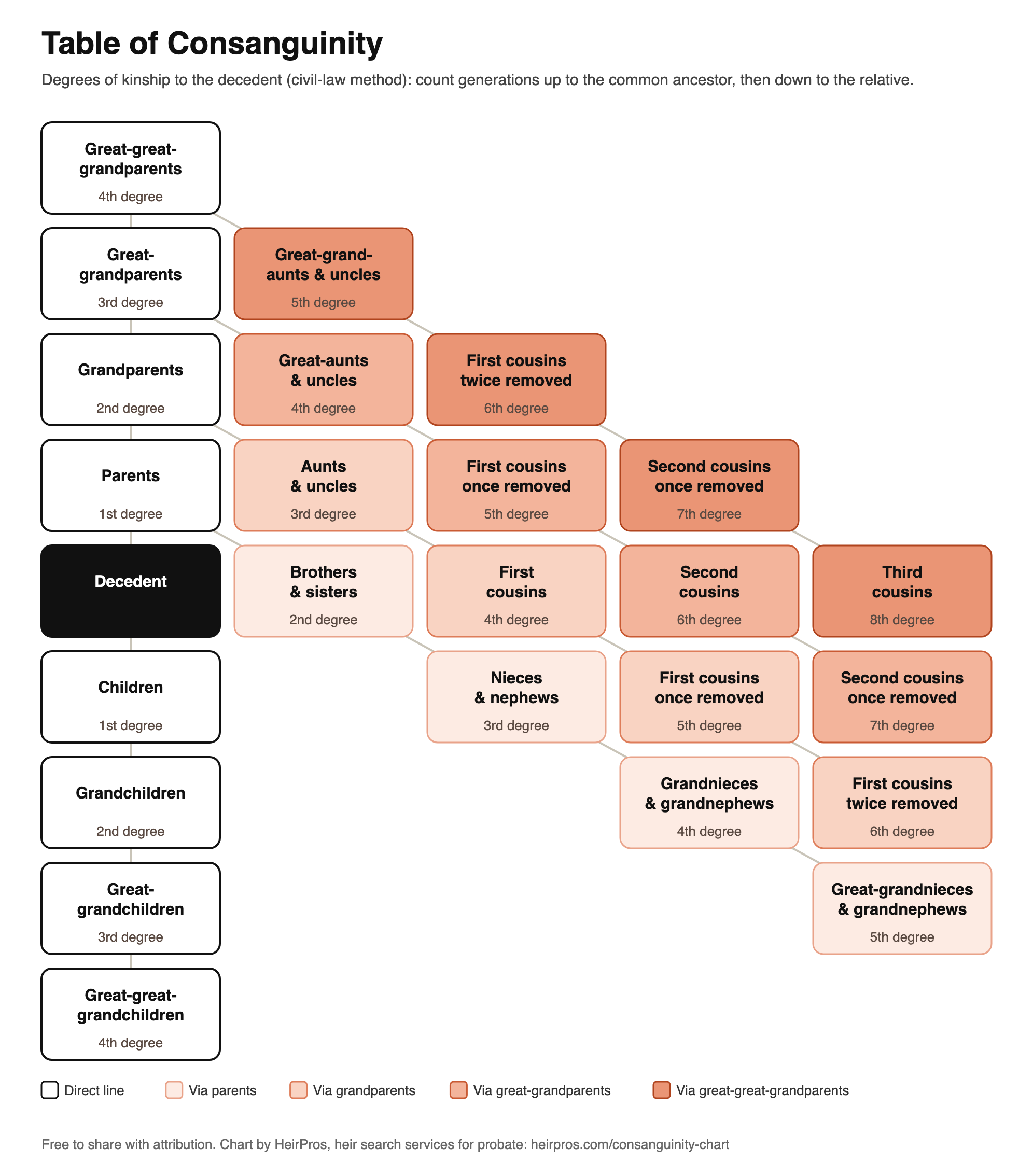
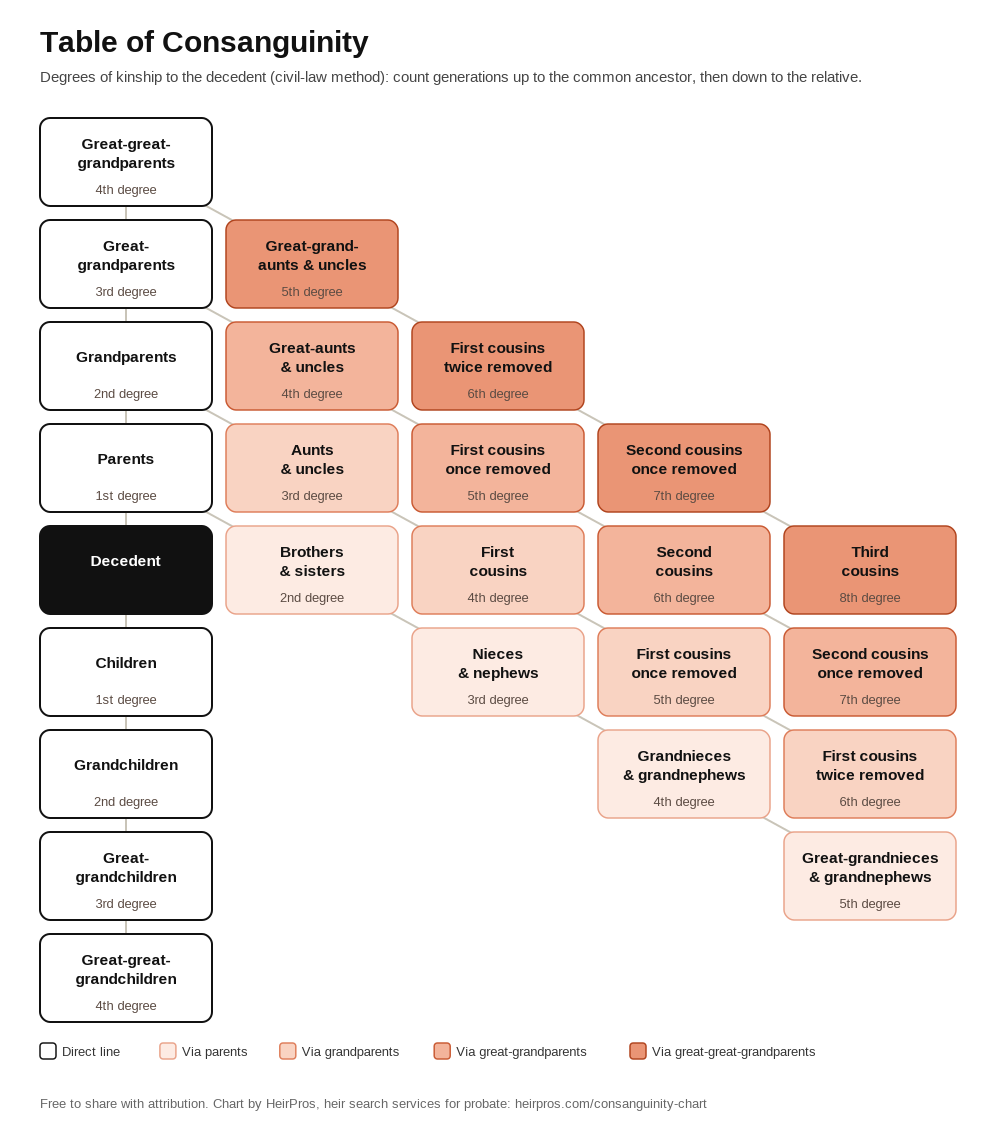
A table of consanguinity shows how closely each relative is related to the decedent by blood. Tap any box to see how its degree is counted. Free to download, print and share.
Scroll sideways to see the whole chart.
Need the name for a relationship? Try our relationship calculator »
How to read a consanguinity chart
- Start at the decedent, the black box. Every degree is counted from the person who died.
- Count up to the closest ancestor the decedent shares with the relative. Parents are 1 generation up, grandparents 2.
- Count down from that ancestor to the relative.
- Add the two numbers. That is the degree of kinship. A first cousin: up 2 to the grandparents, down 2, so 4th degree.
The lower the degree, the closer the relative. When there is no will, intestacy laws generally give the estate to the closest class of living relatives, and the chart is how attorneys and genealogists show the court who that class is.
Degrees of kinship table
| Degree | Relatives of the decedent |
|---|---|
| 1st | Parents, Children |
| 2nd | Grandparents, Grandchildren, Brothers & sisters |
| 3rd | Great-grandparents, Great-grandchildren, Nieces & nephews, Aunts & uncles |
| 4th | Great-great-grandparents, Great-great-grandchildren, Grandnieces & grandnephews, First cousins, Great-aunts & uncles |
| 5th | Great-grandnieces & grandnephews, First cousins once removed, Great-grand-aunts & uncles |
| 6th | First cousins twice removed, Second cousins |
| 7th | Second cousins once removed |
| 8th | Third cousins |
Degrees by the civil-law method. Under the canon-law method, count only the longer line: first cousins are 2nd degree, second cousins 3rd.
Who inherits first when there is no will?
Every state has its own intestacy statute, but most follow the same general order, close to the Uniform Probate Code:
- Surviving spouse (not on the chart: related by marriage, but always first in line for a share).
- Descendants: children, then grandchildren and great-grandchildren in place of a child who died.
- Parents.
- Descendants of the parents: brothers and sisters, nieces and nephews (Tier 1).
- Grandparents and their descendants: aunts, uncles and first cousins (Tier 2), often split between the maternal and paternal sides.
- More distant next of kin, by degree, in states that go further (Tier 3 and beyond).
- The state (escheat), if no heir can be found.
Whether a share passes "per stirpes" or "by representation" changes how much each heir gets, so always check the statute for the decedent's state of residence (and the state where any real estate sits).
Not sure who is on your decedent's chart? That is what an heir search is for. HeirPros genealogists identify every heir, cite the record behind every relationship and sign the affidavit. Flat fee from $595.
See our heir search services »Use this chart on your website
Law firms, bar sections, courts and genealogy societies are welcome to use this chart. Copy the code below into your page. It shows the chart and credits HeirPros.
Prefer a file? PDF for printing · PNG image · SVG (vector)
Consanguinity chart FAQ
What is a consanguinity chart?
A consanguinity chart (or table of consanguinity) shows how closely each relative is related to a person by blood, measured in degrees. Probate courts and attorneys use it to work out who the next of kin are when someone dies without a will, and which relatives inherit first.
How do you count degrees of consanguinity?
Under the civil-law method used by most U.S. states, count the generations from the decedent up to the closest common ancestor, then down to the relative, and add them together. A first cousin is two generations up to the shared grandparents and two down, so 4th degree.
What degree of kinship is a first cousin?
A first cousin is related in the 4th degree under the civil-law method, and the 2nd degree under the canon-law (common-law) method, which counts only the longer of the two lines.
What is the difference between the civil-law and canon-law methods?
The civil-law method adds the generations up to the common ancestor and down to the relative. The canon-law method counts only the generations in the longer line. Most U.S. states use the civil-law method for intestate succession, so that is what this chart shows.
Do half-siblings inherit the same as full siblings?
In most states, yes: relatives of the half blood inherit the same share as relatives of the whole blood. A few states, including Florida and Texas, give half-blood relatives a half share. Check the intestacy statute for the decedent's state.
Do in-laws and step-relatives inherit?
Generally no. In-laws and step-relatives are related by affinity (marriage), not consanguinity (blood), and usually do not inherit under intestacy laws. A surviving spouse is the main exception, and a few states let stepchildren inherit if there are no blood relatives.
How far out does an heir search go?
As far as the state's intestacy law requires to find a living heir. Under the Uniform Probate Code the search ends with the descendants of the grandparents; many states go further, out to great-grandparents' lines or "next of kin" in any degree, before the estate escheats to the state.
Can I use this chart on my website or in a filing?
Yes. The chart is free to download, print and share. If you publish it online, please credit HeirPros with a link to this page; the embed code below does that for you.
More on consanguinity and heirship
- What is a consanguinity chart and how is it used in probate?
- The legal aspects of consanguinity in probate cases
- Consanguinity search types
- Relationship calculator: what is a first cousin once removed?
- Affidavit of diligent search template (free Word and PDF)
- Who inherits without a will, by state
- The legal definition of unknown heirs
Talk to Us About Your Case
Schedule a free call about your case and deadline, or get an instant flat-fee heir search quote. Your information is NEVER shared.